Employee on/offboarding
People move on. Know-how stays.
Turn your team’s experience into the handover nobody had time to write. Help the next person start with the knowledge already there.
Let people explain. Keep what they know.
Twenty years of experience. Three months to hand it over. The most useful knowledge is still in someone’s head.
Watch the product walkthroughCapture the job
Short interviews and system walkthroughs capture tasks, exceptions and the contacts that keep things moving.
Give it a home
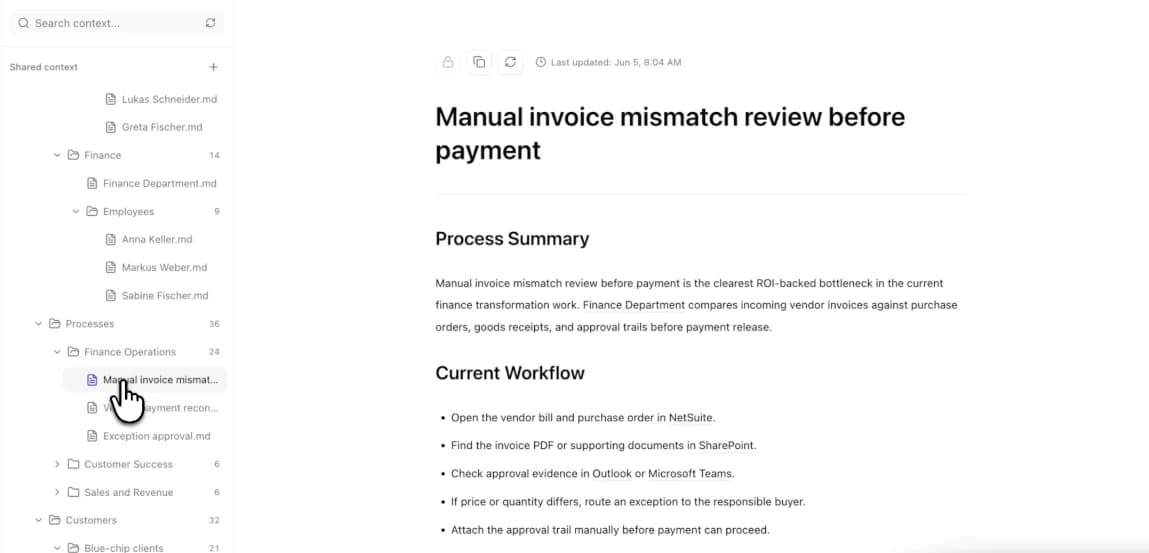
Role handbooks and recordings stay together in one knowledge hub for your department.
Put it to work
New hires read, watch and ask. Your team sees which repetitive tasks could be automated before re-hiring.
Common questions.
Who is this for?
HR and people teams, department heads, and operations leads who lose know-how at every departure and re-explain the job at every hire. It covers retirements, resignations, and key-person risk on one side, and teams that hire in volume on the other, from a single role to a whole department.
When should the handover interviews start?
At notice at the latest. For retirements and for roles where one person holds the process, earlier: months ahead, while there is still time for follow-up questions and to record the system tasks as they are actually done.
How much of the leaver's time does it take?
Short voice interviews with the agent, spread across the notice period, plus recording system tasks as they do them. Nobody has to write a handover document; the agent asks, follows up on what it hears, and structures the answers into the role handbook.
What if the person has already left?
Interview the people who hold the knowledge today: the colleague who covered the role, the manager, and the people upstream and downstream of its handoffs. The same interviews work for capturing a role that is not changing hands yet but depends on one person.
What does a role handbook contain?
The tasks, timing, exceptions, and contacts as the person described them, with a recording beside each process step they walked through in a system. Every section stays linked to the conversation it came from, so a new hire can read the summary and watch the step behind it.
Will leavers take part, and will they be candid?
The conversation is short, runs in their own language by voice or text, and treats what they know as worth keeping, which most people prefer to leaving their successor to start from scratch. Anonymity is set per campaign: anonymous, named, or the participant's choice, and every participant sees the setting before they start.
How does onboarding change for the new hire?
New employees work with the knowledge hub from day one. They read what the people who did the job actually said, watch the recording behind each process step, and ask the hub their questions instead of a colleague. The same questions stop coming up five or ten times a month, and the colleague who used to answer them gets their time back.
Does the knowledge go stale?
Roles change, so run the capture again whenever a role changes hands or a process changes. The new conversations join the same hub in your workspace, and the handbook reflects the latest account rather than the first one. Your team and your AI tools can query it via MCP at any time.
What is the AI automation backlog?
Every handbook shows which parts of a role were repetition and handoffs. The backlog collects them, so before you hire for a role again you can see which of its processes to automate instead. Ontora covers the capture and the backlog; you decide who builds it, whether your own team, a partner, or Ontora's execution agents.
Where does our data live, and who can see it?
Your data belongs to you; Ontora processes it on your behalf under a data processing agreement. You choose hosting in the EU or the US at signup, and EU customer data stays on EU servers. Interviews and recordings are used for your workspace only and are never shared with other customers. You decide who in your organization can see transcripts, recordings, and handbooks, and an on-premise setup is available on request. The subprocessors we rely on are listed publicly.