Change management
Help the change take hold.
Listen to the people living through it. Recurring conversations reveal what’s working, what’s breaking, and where your team needs to act.
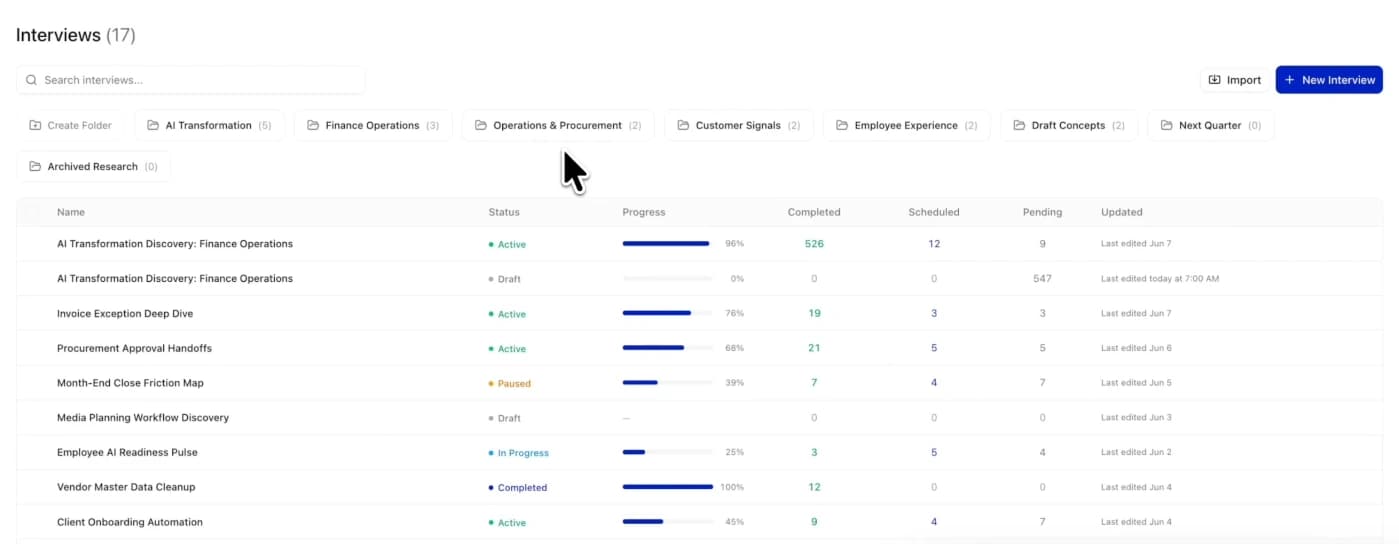
Listen. Adjust. Check in again.
Training is complete. The status is green. But are people working the new way, or quietly rebuilding the old one?
Watch the product walkthroughStart with a baseline
Hear from everyone affected before the change, while their experience can still shape the plan.
Return after each milestone
The same people, the same core questions. Find out what works and what still gets in the way.
Act, then listen again
Your programme team reads each round against the last, prioritises fixes, and checks whether they landed.
Common questions.
Which kinds of change is this for?
Long transitions where the people affected need to be heard more than once: ERP, CRM or HRIS migrations such as SAP ECC to S/4HANA, a new operating model after a merger or reorganisation, a company-wide rollout of new tools or AI agents, or a process redesign across several sites. A one-off announcement doesn't need it. Anything that runs for months does.
When should the first campaign run?
Before the design is frozen, while the baseline can still change it. If the transition is already under way, start now: the first round becomes the baseline, and every later check-in is read against it.
How often are the check-ins, and how long do they take?
You set the rhythm. Weeks two and six after a go-live are the usual start, then monthly or at each milestone for the rest of the transition. The baseline takes about 20 minutes per person; the check-ins are shorter and ask the same core questions each time, so the answers stay comparable from round to round.
Who is this for?
The people carrying the transition: the transformation office or PMO that needs to see where readiness differs by team or site, the process owners and key users who are asked to speak for every user, HR or change leads responsible for how the change lands with people, and the IT team or implementation partner who has to deliver it. One evidence base answers their different questions without another reporting layer.
Does this replace our change team or the implementation partner?
No. Workshops, communication, training and implementation expertise remain part of the programme. Ontora gives them evidence from everyone affected instead of a sample, on a rhythm instead of once, and a traceable backlog to work from. Your implementation partner can work in the same workspace, or run the campaigns themselves.
Will people keep answering, round after round?
Each check-in is a short conversation by voice or text, in the participant's own language, and it follows up on what they say instead of walking them through a form. Participation is visible per round, so you notice when a team goes quiet, and a team going quiet is itself a finding worth a conversation with its lead.
Will people be honest during a restructuring?
More honest with a neutral interviewer than with their manager, in our experience, provided the setup is right. Anonymity is set per campaign: anonymous, named, or the participant's choice, and every participant sees the setting before they start. The results describe teams and processes, not individuals, and recommend rather than decide; nobody is rated or assessed on the basis of a check-in. Where a works council or employee representatives are involved, the setup is agreed with them before the first invitation goes out.
What exactly does the picture over time show?
By team and site: which issues were raised in the baseline and whether they were resolved, which persist round after round, which are new, and where teams describe the same step differently. Every point links back to the conversations behind it, with a count of how many people said it, so a trend can be checked against what people actually said.
How do the findings get into the programme?
As a backlog prioritised by how many people depend on a workaround, which roles are affected and what depends on it downstream. Explore it in the workspace, export as PDF, Markdown or CSV, or query everything from your own AI tools via MCP. After the transition, the conversations become the baseline for process mapping once the new way of working has settled.
Where does our data live, and who can see it?
Your data belongs to you; Ontora processes it on your behalf under a data processing agreement. You choose hosting in the EU or the US at signup, and EU customer data stays on EU servers. Interview data is used for your workspace only and is never shared with other customers. You decide who in your organisation can see transcripts and results, and an on-premise setup is available on request. The subprocessors we rely on are listed publicly.